How Intelligent Systems Change the Design of Organisations
A Management Theory for the Age of AI
Coming soon.
Organisations have always been designed around human intelligence. That assumption is changing.
As intelligent systems become participants in real work, they change more than productivity. They affect where judgement sits, how work is coordinated, what can be delegated, how decisions are made and ultimately how organisations themselves are designed.
How Intelligent Systems Change the Design of Organisations develops a management theory for organisations operating with both human and machine intelligence.
The book asks a fundamental question: how do intelligent systems change the design of organisations?
What the book explores
The book examines intelligence, management, work, operating models, implementation, organisational learning, delegation, governance and the changing relationship between human and machine intelligence.
At its centre is a practical argument: organisations cannot fully design the consequences of intelligent systems in advance. Implementation reveals things about workflows, judgement, coordination and structure that could not always have been known beforehand. The challenge is to capture that learning and use it to evolve the organisation.
Follow the work on Substack →
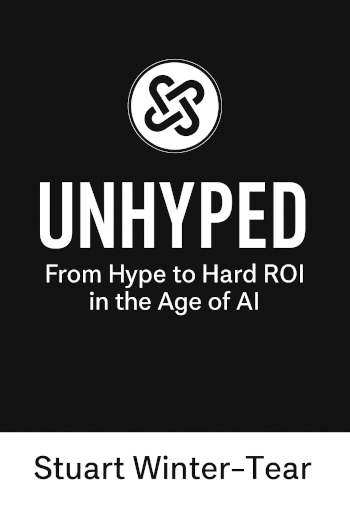
UNHYPED: From Hype to Hard ROI in the Age of AI
State change. Receipts. Outcomes that survive daylight.
Published 2025
Buy the Book (PDF)Want a taste before buying? Read the free preview →
About UNHYPED
Most organisations are under pressure to do something with AI. Activity is easy to create. Value is harder.
UNHYPED is a practical field guide for leaders moving AI beyond demos and experimentation into real work. It focuses on workflows, delegation, governance, controls and the economics required to turn technical capability into measurable organisational outcomes.
Its central argument is simple: you do not buy AI. You buy state change. The book explores why agents are workflows in disguise, how to design autonomy with appropriate controls, how to make governance operational, and how to measure whether AI is creating genuine value rather than simply moving cost and complexity elsewhere.